
An innovation framework for age-friendly cities
As cities take on disruptive challenges, in particular harnessing technological disruptions and managing ageing populations (see earlier post about updating 'age-friendly' here), this note suggests a five-stage framework to guide cities along their innovation journey. It's designed to be more descriptive than prescriptive - each city will implement in its own way and in line with their other age-friendly priorities.
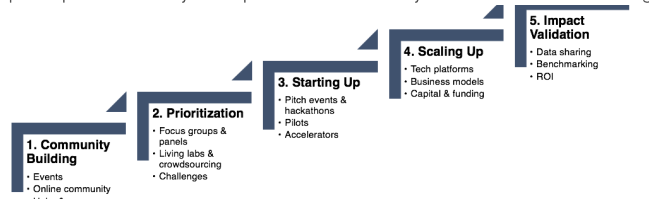
Five Stages for building an innovation agenda for age-friendly cities
Stage 1: Community Building
A broad-based interdisciplinary community of local people interested in innovation in ageing, made up of: older adults themselves, startups (separated from industry in general), industry, governments, investors and academics and NGOs / CBOs. Events are often the easiest, tangible steps to galvanize the community and create deadlines. An online-community enables the conversation to continue and people to share profiles and interests. Hubs & spaces provides year-round, visible gathering places, and offer an excellent opportunity to drive intergenerational engagement.
Events
In spite of the remarkable progress in video networking and virtual reality (or perhaps because of it) in-person meetings seem to have become more, not less, important. Physical meetings provide energy, inspiration and serendipitous connections outside of one’s echo chamber that algorithms and digital channels have not (yet) been able to match. Events can also serve as a deadline for a process and force consensus. There are now a myriad of events focused on innovation in ageing, some of which include:
Ageing and senior care events around the world such as the Senior Living Innovation Forum, NIC, Ageing Asia, NOBEL Dialogue event on Ageing, LA’s Aging into the Future, D.Health Summit, Helsinki’s SLUSH, which has the Digital Silver event, the Boomer Venture Summit, events by the European institutions, and others.
Most regions are now hosting innovation events focused on showcasing local talent and connecting with a broader audience. Some examples include North of England VentureFest and the Great Exhibition of the North in Newcastle, UK, Oslo’s Innovation Week, and Singapore’s Switch.
Online community
While events come and go, a online stakeholder communities maintain connection during the gaps. An online community lowers the ‘acquisition costs’ of attracting attendees to one-off events and getting new initiatives up to speed. The goal is to support connection between different parts of the ecosystem, help determine key strategic priorities and support implementation. Examples include:
Age-friendly world is a website run by the WHO to allow age-friendly cities and communities to list their initiatives (though doesn’t run as an online community with member profiles and messaging etc).
Aging2.0 Chapters are volunteer-run groups in 50 cities in 20 countries and are focused on connecting local people around innovations and showcasing local talent on a global platform.
Facebook, with its 2bn members and coverage is in many ways the default online community for everything. According to Pew Research, 67% of older Americans are online and 62% of those (so roughly 4 in 10 of every person over 65 in the US) use Facebook. Its recent push for blood donors in India created 6m new donors in a single day, testament to the incredible potential of its 2bn person membership.
Locally focused social networks such as Next Door, the 200-strong Villages movement, or the soon-to-be released Iris social network, focused on ‘perennials’ in Orange County.
Other senior-focused organizations (AARP, Age UK), or volunteer groups that skew towards seniors (e.g. Rotary Clubs, Freemasons). In additional there are health-focused communities such as Health2.0 and regional-focused efforts (such as the Innovation Supernetwork in the Northeast of England) which could have ageing as a local priority.
Hubs & spaces
While events gather people together for a focused day or two, an ‘hub’ for innovators in ageing provide a very visible and tangible platform to bring people together throughout the year. Intergenerational innovation hubs - those that bring together startups of all ages with older adults - are still more theory than reality but we expect to see the first examples launch in 2018. There are already many local hubs for seniors - across the US there are approximately 11,000 senior centers which act as local hubs and service providers, while PACE programs, pioneered by OnLok, provide a full set of services including healthcare for a capitated payment. Promising platforms that could become intergenerational innovation hubs include:
Senior Planet is a thriving tech-focused hub for seniors created by non-profit OATS in the center of Chelsea, Manhattan.
Louisville’s Thrive Center is a 7,500 sq ft space to showcase innovative technology and run educational programs for the community.
Badalona, outside Barcelona, has developed a intermediate care for the elderly concept that is based on a physical hub in the center of the community.
Finally, a number of new prestigious senior care communities are being created in Manhattan that will redefine senior care in the city: Inspir by Maplewood (who have just launched a Center for Aging Innovation) and Welltower. Some CCRCs are taking the lead on community initiatives too and would be natural local innovation hubs.
Stage 2: Prioritisation
An organic, bottom-up community needs to be focused on local priorities to be effective. The WHO age-friendly process has done this well - with strategic plans based on local consultation. Focus groups & consumer panels can be developed for specific companies or events. Living labs offer the ability to get longitudinal input over time while crowdsourcing virtualises this, enabling ideas to come from anywhere and be built on collaboratively. Finally, Challenges make a public call for innovation based on the agreed strategic priorities.
Focus Groups & Panels
Many innovators in ageing have been inspired by a grandparent, but need to engage a more representative group of older adults. Traditional consumer research, designed for deep-pocketed consumer goods’ companies, is generally not appropriate. Consumer panels are generally convened ad hoc in response to requests from specific companies.
Platforms that tap into the wisdom of experts play a role here. Maven, a San Francisco-based startup allows companies with specific questions to contact relevant experts in their community, many of whom are retired professionals with current skills looking to earn some additional income.
Living labs & crowdsourcing
Living labs allow for ongoing immersion in daily lives. The European Network of Living Labs (ENOLL)FOOTNOTE: Footnote, define living labs as “user-centered, open innovation ecosystems based on systematic user co-creation approach, integrating research and innovation processes in real life communities and settings”. Examples include:
Newcastle University has developed Voice (‘Valuing Our Intellectual Capital and Experience’) which is not merely a consumer panel but a way to harness the unique skills and experiences of their 6,000 strong diverse membership base.
Newcastle is also building 300 multi-generational ‘homes of the future’ in their town centre location adjacent to the new National Innovation Center for Ageing.
COTA South Australia has developed a Plug In concept that will connect businesses to older people. Also in South Australia, the government has secured $11.4m to fund a new AgeingWell entity and a new Living Laboratory for four years.
Living labs are generally small scale and the insights generally only available to that geography or project. An online crowdsourcing platform that capture ideas from older people and helps co-create new products is something that has been discussed among various organizations but not yet implemented at scale. There are similarities with corporate innovation platforms that seek expert input. The closest examples we’ve seen include:
Quirky the New York-based platform that allows people to submit product ideas and then share in the revenues if the product is created.
Corporate innovation platforms (such as Imaginatik) harness the wisdom of the crowds to generate new ideas.
This is an area in which we expect to see more innovation in the coming year - stay tuned for updates here.
Challenges
Challenges takes these priorities to the next level - by focusing on a subset of key topics and (often) issuing public calls for innovators to focus on specific priorities. Examples include:
Aging2.0’s Grand Challenges focus the global innovation community on eight key priorities for older adults, the industry and innovators themselves.
IDEO’s OpenIdeo’s platform has been used to initiative numerous Challenges around ageing such as a fall prevention challenge with AARP.
Toronto’s CABHI runs a variety of Challenges and open calls around brain health.
Bloomberg Philanthropies Mayors’ Challenge, which attracted 550 US cities to its 2017 call, provides support for cities to tackle high profile initiatives.
Others include: Startup Health’s Moonshots, InnovateUK, Citymart (public procurement innovation) and the West Midlands’ Urban Challenges.
Stage 3: Starting Up
This is where cities will face a big cultural challenge - thinking like a start up. Specifically, this is about low-cost testing of new concepts, an ‘agile’ approach (iterating with end users), embracing failure for the lessons it teaches and ‘pivoting’ when a new direction is needed. Pitch events & hackathons showcase local startups or spend a weekend developing new concepts. Pilots engage industry and government partners willing to try out (then scale) new ideas, while accelerators bring in investors to provide seed capital and mentorship specifically focused on startups.
Pitch events & hackathons
Hackathons bring tech coders together, usually over a weekend, to work on a specific problem, often with the end users themselves. Initially the preserve of geeks, hackathons have become a mainstream tool, adopted by companies large and small to focus on creating tangible concepts (e.g. after a weekend of coding) to strategic challenges. Case studies include:
Aging2.0 ran a hackathon at Google Campus in London which brought together 70 developers and 10 seniors for a weekend to improve travel options for older adults.
UK-based Auriens ran a 70-person hackathon in London to conceive and develop new ideas for ageing population.
Others: DementiaHack 2017 by HackerNest in Toronto partnered with the UK Consulate General, OneLeap has ‘productized’ the hackathon as a corporate venture offering and a new group, Hack Mental Health is organizing a Feb 2018 hackathon with tech execs from Silicon Valley to focus on an often overlooked problem.
Pilots
For startups landing a pilot with a potential customer is often considered a major victory, and when it all works out, can lead to validation of the concept, mutual fit and additional referrals and business. Unfortunately, all too often pilots don’t lead to a
Accelerators
Ask any entrepreneur in the ageing space what challenges they’re facing, and they’ll generally talk about access to consumer insights, distribution, business models and funding. Despite the large population and size of the ‘longevity economy’, which according to estimates by AARP and Oxford Economics accounts for up to half of US GDP, there is still a paucity of venture funding (apart from over $200m in home caregiving networks in recent years). Examples include:
Aging2.0 ran an accelerator, the Academy, in 2014 and 2015, which supported over 30 companies . (There have been a number of exits so far, though no ‘unicorns’...)
Modern Aging in Singapore is a collaboration between NUS and Access Health, and runs an accelerator program for promising startups in ageing.
Others: Adaptation Health, from Louisiana, is developing plans for a Medicaid-focused incubator. Startup Health and 500 Startups among others have a number of promising startups in their portfolio. ImpactHub Singapore and Zurich have created corporate accelerators that allow partners to have access to their co-work space and the startups within it.
Stage 4: Scaling Up
While starting up challenges cultures and norms, scaling up challenges entrenched business models and vendors and is therefore the most challenging. Moving from small scale tests and pilots to large scale implementation of promising ideas (that have political support) requires three things First, tech platforms that can integrate multiple services and scale. Second business models that connect healthcare savings with innovation activity and align incentives. And third capital & funding to support breakout startups so they can compete with established vendors.
Tech platforms
Language in this space can be confusing - communities, ecosystem and platforms can often be used interchangeably. While there may be a community around a tech platform (with tech developer communities being obvious examples) the two don’t have to overlap. Designing tech platforms for older adults is fraught with complexity, since it will need to include a comprehensive range of services (health, transport, financial services, media etc), stay with the individual into and out of a variety of settings (home, hospital, rehab, nursing home, hospice etc) and also be both attractive, simple and well-designed enough to not be stigmatized, yet functional and complex enough to connect with the health system and offer necessary security / features. Further, there are multiple gatekeepers (family members, senior living staff, local services providers) so the user is not necessarily the buyer, and there is not as year a scalable and accessible distribution channel direct to older people looking to stay independentFOOTNOTE: Footnote. There is no winning platform yet, but some approaches include:
Consumer tech / smart home: Consumer tech titans are investing heavily in the space, and most are looking to ageing-focused use cases. Apple’s Care Kit can be used with Parkinson’s) and Amazon is working with Accenture and Age UK on this use case for their Alexa. IBM and Nokia are collaborating on an ageing in place platform, and we expect other smart home platforms such as Google’s Home, Samsung’s SmartThings, Loxone, Iris by Lowes and Wink (among others), to increasingly target this demographic.
Institutional / healthcare: The Personal Connected Health Alliance, an organization connected to US hospital non-profit HIMSS, is pulling together an industry coalition, and their Continua tech platform is directly focused at the home market. Based on comments from the new HIMSS CEO, expect them to increasingly target the ageing space.
Middleware platforms are looking to connect different service providers. Validic with almost $20m in venture funding, connects consumer healthcare data, Veritage Solutions is a new entrant focused on assisted living market, and startups Cubigo (Belgium-based, partnering with Apple) and OnKol aim to connect together a range of products and services associated with keeping people at home. The European Union has supported various IoT / middleware projects such as Universaal, Reaal and most recently Activage.
Business models
Manchester is one of a growing number of cities in the UK that has taken over funding for the provision of local services, and manages its own social care and healthcare budgets. As such, they’re in a better position to ‘join the dots’ than many other cities which wouldn’t realize the full benefits for investing in non-medical interventions. ‘Closed systems’ align their input and outcomes.
One interesting type of innovation here, which aligns incentives among a disparate group of stakeholders, is the social impact bond (SIB). This is a financial instrument that allows a beneficiary (such as a government) to specify the social outcomes they’re looking for (such as a reduction in loneliness in a population) and commit to pay the service provider only if those results are achieved (and validated). The service provider can use this ‘bond’ to attract more risk-tolerant capital (such as from charities or impact investors) to pay the up-front costs of the new project, and provide a return to these investors once the project is a success. So far SIBs have mostly been used for prison recidivism and education, however a reduction in healthcare costs for ageing populations could show more immediate short-term benefits. Examples include:
Meals on Wheels is negotiating a social impact bond to receive dividends if the recipients of their service have improved health outcomes.
Bridges Ventures backed a ‘social prescribing’ social impact bond to help 11,000 people in Newcastle engage with non-medical interventions to improve their health.
Hive is a concept for ‘thriving in community’ (by the author) using a tech platform to keep older people independent longer, and reward the innovators for collaborating.
Capital and funding
There are three main types of capital available for growing startups, venture, strategic and impact.
Venture: Traditional venture firms have been relatively slow to the ageing space, but a few notable exceptions include Andreesson Horrowitz, Northstar Ventures, Thrive Capital, Insight Venture Partners and GV.
Strategic: These are investors who also have operations in the space. Revera, Auriens, McKesson Ventures, Providence Ventures, KP Ventures, Sompo, Generali, Generator Ventures GE Ventures, Ziegler, and Cambia Health, are active here.
Impact: These focus on the social and environmental impacts as well as financial returns and include: Bridges Ventures, Omidyar Network and the Gates Foundation. More here.
Stage 5: Impact Validation
Stage 5 is about measuring impact and ROI. Despite being the last stage it should be thought about before any implementation, along with the priorities, so necessary benchmarks are in place. Data sharing will be key - ensuring key data are available and interoperable. Benchmarking enables the ability to show progress over time and also compares the city with its peers, while Return on Investment (ROI) is the ultimate yardstick; which can be applied to at least four objectives: quality of life, healthcare costs, healthcare quality and economic growth.
Data sharing
Data sharing is a key step to enable cities to measure impact. Unfortunately, the trend in recent years has been for consolidation by the large technology players (in particular Google, Apple, Amazon and Facebook) who ‘own’ the data generated by users across their ecosystem, and so it can be hard to have a holistic view. Cities should be sure to engage partners that are willing to adopt a collaborative approach to sharing data, and look into emerging initiatives (such as ‘data philanthropy’) that recognize that residents’ data should be easily accessed and shared according to their preferences, and commercial organizations don’t develop unique control points.
Benchmarking
Benchmarks record the current state of before an intervention happens, and are therefore vital to be able to identify whether progress has been made. They can also be used to compare performance of cities with others. There are a number of city indices that have been developed to compare ‘best places to live and work’, with Milken Institute’s Best Cities for Successful Aging a thoughtful analysis of multiple factors that determine livability (although not innovation capacity).
Returns on Investment (ROI)
We can interpret ROI to broadly apply here - not just financial returns but all of the goals that were initially laid out for building the next generation of age-friendly environments:
Improved quality of life for older adults and residents in general: Cities that work well for older people work well for all. A variety of ways to measure quality of life exist, which can include direct measurement by surveys as well as use of indirect /proxy measures (such as engagement with online or offline activities).
Lower healthcare costs: Measuring the costs of healthcare will include care in all settings (in-patients, out-patient and homecare) as well as social / indirect costs that often aren’t captured (e.g. caregiving costs).
Improve healthcare quality: Healthcare quality can be measured in three ways, structural measures (e.g. the use of electronic medical records, the ratio of doctors to patients, process measures (e.g. the number of older people with chronic care receiving remote care monitoring) or outcomes measures (e.g. life expectancy, intervention mortality rates).
New economic activity: This is tapping into the ‘silver economy’ thesis of the significant market potential in this space. These could be new jobs in startups or existing players, attraction of capital and funding and growth in revenues and profits of local organizations.
Innovation In Action : Case Study - Resilient Cities
The Rockefeller Foundation’s Resilient Cities initiative is a $100m effort to support 100 cities with $1m grants to develop strategies (and employ Chief Resilience Officers).
Resilient Cities has engaged philanthropists and cities at scale and caught the imagination of city officials in way that should be inspiring to those seeking to ignite change around the ageing agenda.
Those looking to add innovation to age-friendly cities could learn from this approach and build on it in three ways. First, while all older people are different, there is likely more commonality in challenges around ageing than resilience (which can cover things as diverse as climate change, infrastructure and terrorism). Second, in many AFCCs the local priorities are already identified, so there is a good starting point. And third, the ageing space already has a track record of engaging volunteers which can lower costs to implement initiatives at scale.
Either way, there should be more collaboration and shared learnings across all these related initiatives so each new idea builds on the others, so that the local city officials, and their residents, benefit in turn.
Conclusion
Although the scale and speed of disruptive trends impacting our cities is unprecedented, there are multiple options and paths for bringing innovation into the age-friendly agenda. This will be familiar for some cities and unchartered territory for others. The next post fleshes out more details of the steps with examples / case studies from different active innovation projects around the world.
Thanks to the following for their insightful comments on earlier drafts: Graham Colclough, Alex Kalache, Stephanie Firestone, Eric Kihlstrom and Jordi Piera Jiménez.