
Can Australia lead the world in preventing elder financial abuse?
For a country in which everything wants to kill you, Australia has a bit of a reputation as a nanny state. Immigration and drug enforcements can be seen as draconian, bicyclists of all ages and abilities have to wear helmets all the time, drink-drive laws are stricter than most, bar staff have a duty of care not to over serve, and some of the public safety videos need an R rating. Given its rapidly growing ageing population, a recent come-to-Jesus reckoning around aged care and a very strong financial services sector, I would not be surprised therefore if the country didn’t step up and take the initiative around the large, growing and increasingly complex problem of elder financial abuse.
[caption id="" align="alignnone" width="317"]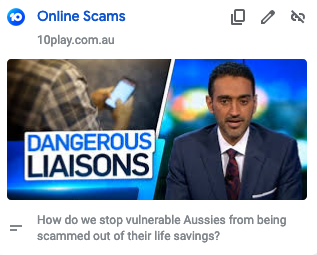
Whilst the short term challenges of an integrated Covid-19 response have occupied headlines, financial abuse is an insidious and growing concern globally. A recent segment of Channel 10’s ‘The Project’ described a heartbreaking story of how an older Adelaide resident, retired nurse Marjan de Wilt was scammed out of around AUD $100k by a foreign romancer-turned-scammer. Mrs de Wilt, a relatively tech-savvy, smart, caring 69-year-old, one of a growing number of older single ladies, was looking for a companion online, and met a nice-sounding chap who ‘catfished’ her. She ended up sending AUD $78k to him in Africa - almost all of her lifetime’s savings and pension - from her NAB account and around $18k in Apple products bought with her Amex card. The show suggests that 4,000 Australians fell victim to these types of romance scams targeted older people in 2019, resulting in a loss of AUD $28.6m.
There is a lurid history of corporations around the world seeking to avoid responsibility for people being damaged, directly or indirectly by their products. Wrapped up tightly in identity and a liberal narrative, American corporations have excelled at this, from the tobacco lobby with cancer to Big Oil with climate change. Interestingly, the seemingly uncontroversial topic of seat belts required a major campaign by public advocate (and later U.S. Presidential candidate) Ralph Nader from the 1960s to change mindsets. In 1956 Ford offered seat belts as an optional item on their cars for $27, and only 2% of people took them up on the offer. As recently as the 1980s, 65% of Americans thought seat belts shouldn’t be required by law. Australia, by contrast, was the first jurisdiction in the world to introduce mandatory seatbelt laws in 1970.
Financial fraud and abuse is more nuanced than cigarettes giving you cancer. As NAB and Amex made clear with their statements after the show’s broadcast, it’s a hard problem and, in words to the effect of, ‘we don’t want to be in the business of micromanaging what people spend their money on’. They already have a duty of care and KYC rules around other types of fraud and law-breaking (and often freeze your card just due to ‘unusual behaviour’ when you need it most on holidays), it’s going to be hard to rely on plausible deniability if these stories keep on making the news. There’s a lot of shame and underreporting associated with this, so the numbers are likely not reliable. I expect there would be outrage if a bank prevented someone from sending their money to their genuine friend or lover abroad, but a ‘hands-off’ approach also doesn’t feel right.
However, this problem is not going away. We’re seeing a dramatic rise in dementia, larger numbers of older people going online, increased ‘social acceptability’ of meeting people online (whether it’s for dating for pickleball), people dating later in life and re-engaging after a divorce or death of a partner and Covid-19 forcing people online to engage socially or access key services. Further, this problem is a particular issue for older women, given they live longer than men.
A report by US-based True Link found that in 2015 financial fraud and abuse was 12x more than previously reported at USD $37bn. In Australia, AUD $634m in scams were reported in 2019, with reports of fraud to Scamwatch up 34% from 2018 to 2019. As dementia increasingly takes its toll, this issue will also start to have a broader impact on the economy - Bloomberg estimates that in 2018, one quarter of Japan’s economy was accounted for by individuals who had dementia. This is a massive burden for the economy, as well as a huge caregiving challenge.
While there are no easy solutions, but there is certainly more that Australia’s financial services could do, on top of their ongoing efforts. Concrete suggestions include:
Educate the public. Changing hearts and minds and raising awareness with more of those brutally effective campaigns, with the key takeaways being don’t click on weird links or trust strangers. Victoria has just reintroduced their shock 1992 seat belts campaign in response to an uptick in deaths of people not wearing their seatbelts. The challenge here is that it’s escalating a culture of fear, lowering the incentives to spend on valid things (and boost the much-needed ‘silver economy’) and often the suggestion is to ‘speak to a family member’, yet 60% of elder financial abuse is carried out by family members.
Ramp up education and training and reporting systems. How well trained are financial services staff to review this? How good are IT systems to detect unusual behavior? Is there any learning going on? The Australian Banking Association suggest that the systems are still not in place, for example they’re lacking somewhere that staff can report suspicious behaviour, and there are inconsistent approaches around power of attorney legislation (e.g. you don’t need to register this formally in Victoria).
Engage the Peak bodies. This seems to come under the remit of a number of groups, such as ABA, older adult organisations such as COTA and OPAN, aged care providers (ACSA, LASA, Aged Care Guild...) and even health workers associations (HFMA). This is a fast moving, tech-forward issue associated with shame, so niche groups targeting this issue are worth engaging (e.g. LifeAfterScams, mentioned in The Project’s piece).
Engage with startups, launch challenges. A number of startups around the world have been created to address this problem such as True Link, EverSafe and SilverBills in the USA and Touco and Kalgera in the UK. (If there are Australian startups, let me know). Startups are good not just for the specific solution they’re building, but to engage in corporate hackathons and innovation challenges where they bring fresh thinking and energy to the topic.
Build a cross-industry, international collaborative to share best practices. This topic is bigger than any one company but also bigger than any industry and any one country. A globally-focused collaborative can be built at the pre-competitive level, and should involve not just the banks and financial services but other sectors including retail, hospitality, tourism, aged-care, clinical experts, data and privacy advocates as well as older people and their families. The outcome could be both broad-based standards, technologies and industry best practices but also an acceleration of startups and tech companies with the power to create efficient, scalable solutions.
Next steps will require a frank and open conversation with leaders of Australia’s financial institutions as well as peak bodies, regulators, academics, older people and businesses keen to help Australia play a leadership role in reducing the alarming rise of elder financial abuse.