
From senior housing to 'healthy habitats'?
This post aims to start a dialogue about where and how we will live in the coming years. We’ll be having a series of events to explore and flesh out these ideas - see below for further information.
Should ‘senior housing’ exist? That’s an odd thing to say about a market estimated to be worth around half a trillion dollars in the US alone. In Australia, a slice of that, retirement villages is worth around AUD $5bn, and most projections assume an upward trajectory for the market globally.
However, two things are worth considering. First, most people (Baby Boomers especially) don’t want the product. In a recent RSL study in Australia, 78% wanted to stay in their own homes when they age and just 3% were happy to move into aged care as it is today (numbers for UK and USA are likely similar). And things are arguably moving in the wrong direction in Australia at least, as aged care homes become more institutionalised.
And second, healthcare is moving away from institutions and back into the home. Although there are many reasons people move into today’s senior care properties, a major one is to get supportive services and easier access to necessary healthcare when they need it. Digital health startups are having somewhat of a bonanza currently with a sizeable chunk of that capital chasing entrepreneurs who are promising to keep people at home longer.
So where to next? Taking a step back, it seems there are three trends converging that will shape people’s lives as they seek later life options - Liveable Cities, Healthy Longevity and the Care Economy - ‘healthy habitats’ - a first version of this concept shared at a senior housing conference in 2020 - sits at the centre. The fact is there’s no ‘senior housing’ circle here because it’s not clear what need is being offered that’s not being met elsewhere.
If senior housing didn’t exist today, would we invent it?
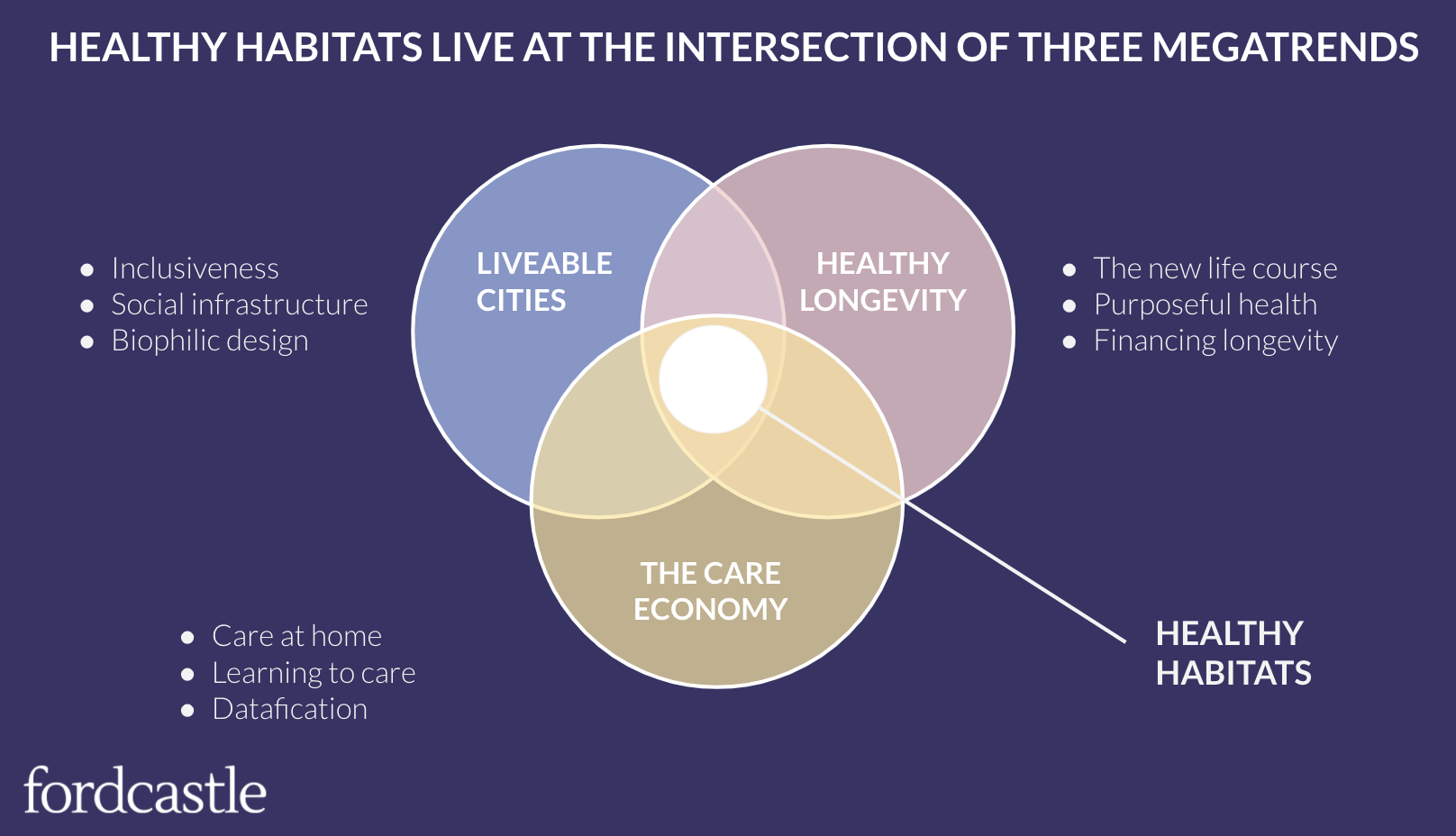
Liveable Cities. According to the EIU, Melbourne used to be the world’s most liveable city, but has stumbled in recent years, and is no doubt exploring ways to take back the crown. The three elements of liveable cities relevant to healthy habitats relate to its inclusiveness, its social infrastructure and to what extent it connects to nature - biophilic design.
Inclusiveness. Ensuring that cities are not just designed for the young and the rich, but work for people of all ages. An urban environment that is inclusive works for all ages, and genders and therefore allows its residents to maximise their contributions - living their lives to the fullest, socially, economically and from a health perspective.
Social infrastructure. Drawing on the term used in Palaces for the People, this looks at how the design of the urban environment can influence health outcomes in a variety of ways, such as the ways it fosters connection and social cohesion with gathering places like libraries and public parks.
Biophilic design. This emphasises the importance of access to nature and the health and social benefits that affords. Melbourne has committed to a plan to increase its urban tree cover from 22% to 40% by 2040, recognizing the benefits of access to nature.
Healthy Longevity. Prevention is better than cure, and ensuring a long and healthy life is a process that should start in the young, not as a response to the onset of disease in later life. Healthy longevity requires a new mental model - aging is living - and a proactive approach to wellness as our health system is now talking about but few are implementing. It also requires new business models to pay for longer lives.
The new life course. The traditional narrative of education > work > retire is being replaced by the reality that lives are now multi-faceted portfolios with overlapping periods of learning, work and renewal. Jobs-for-life are giving way to shorter term roles, gig jobs and new source of income, learning and intergenerational connection, with new end of life options.
Purposeful health. 60% of health outcomes is driven by lifestyle factors, with 40% relating to medical care and genetics. And of that 60%, purpose and meaning plays an outsize role, given it can be a key to behaviour change. Rather than treating isolated diseases, a holistic approach to wellness focused on prediction and prevention that emphasises purpose and meaning will be increasingly important.
Financing longevity. New funding models to pay for longer lives, for example including a ‘business model for healthy ageing’, with a network of product and services providers rewarded for delivering healthy ageing.
The Care Economy. Supporting those who care for others is not just a moral imperative but an economic one - today’s economy doesn’t recognise and reward formal and informal carers and as a result we have less care, less support for carers and fewer products and services that could support carers. To untap the enormous market around care (an estimated $648bn in the US alone) radically new approaches are needed.
Care at home. Pushing acute and chronic care from institutional settings to homes and communities, creating new economic opportunities while delivering better outcomes at lower costs.
Learning to Care. The fastest growing category of jobs is caregiving, yet demand is set to outstrip supply for years to come. Despite booming demand, carers face low wages, poor conditions and few career prospects. New tools to educate and support a much broader segment of the population to be caregivers are needed.
Datafication. Data is the new voice of the consumer, and a functioning care economy requires new taxonomies, standards and protocols to define roles and allow interoperability and integration of products and services.
This is a topical issue for many in Australia, the UK and the US in particular as the senior housing market seeks to reset and rebuild after a challenging pandemic.
We’re looking to have a discussion around this topic in collaboration with Aging2.0 in Melbourne, Sydney and Adelaide in the coming weeks. Get in touch if you’d like to explore this concept further.